The backend contract
supplies before the core loads: gfx and sys. It assumes ten gfx calls
and one sys call exist, and nothing else. Everything below is what the
core actually invokes, verified against the source.
Coordinates are pixels. Colours are 24-bit 0xRRGGBB everywhere; the
backend converts to its own depth (5-6-5 on the panels, RGB bytes in the
pure-js buffer). The conversion is not lossless on every host and an
app must not compare exact colours across backends: the terminal emits
true-colour SGR only when COLORTERM says the terminal can take it and
otherwise quantises to the xterm-256 cube
(backends/terminal/src/backend.js), and the glass emulator quantises
its anti-aliased text and corners through RGB565 to match the panel.
The ten calls
Section titled “The ten calls”| Call | Meaning |
|---|---|
gfx.clear(color) | Fill the whole surface. Start of every frame. |
gfx.rect(x, y, w, h, color, radius) | 1px outline, optionally rounded. radius may be 0. |
gfx.frect(x, y, w, h, color, radius) | Filled rect, optionally rounded. The workhorse call. |
gfx.circle(x, y, r, color, filled) | Centre, radius, boolean filled. |
gfx.line(x0, y0, x1, y1, color) | 1px line. The core draws thick lines as parallel 1px lines itself. |
gfx.text(x, y, size, color, str) | Draw str at integer size multiplier size, top-left origin. The core never rasterizes a glyph; font choice is entirely the backend’s. |
gfx.clip(x, y, w, h) | Set THE clip rect. A single rect, not a stack — the core intersects nested clips itself (pushClip/popClip) and always hands you one honest rect. |
gfx.unclip() | Remove the clip rect. |
gfx.width() | Logical surface width in pixels. |
gfx.height() | Logical surface height. |
Plus:
| Call | Meaning |
|---|---|
sys.millis() | Monotonic clock, milliseconds. Drives timers, cursor blink, long-press, fling velocity. |
That is the whole required surface. The ESP32 stdlib definition
(backends/esp32/engine/native_api.c) declares exactly these tables; the
same names bind to C functions there and to plain JS functions in
backends/pure-js/src/backend.js. “Exactly” is literal — that table has
ten gfx entries and six sys entries and nothing else, so the in-tree
ESP32 target has no poly and no blit; the device-side ones come from
the out-of-tree firmware plus backends/esp32/tools/device-shim.js.
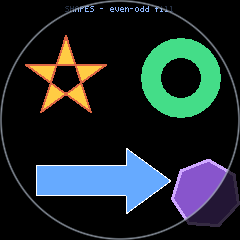
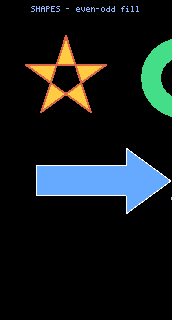
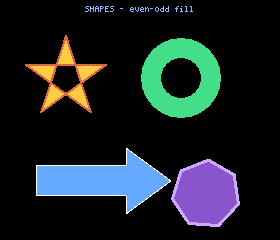
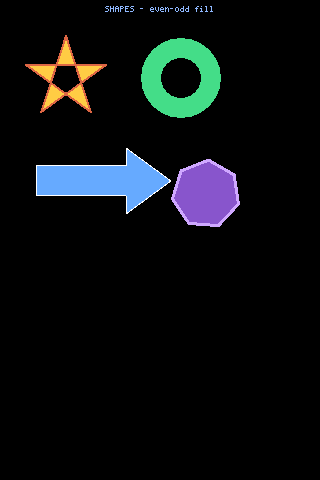
examples/shapes exercises every one of those calls in a single frame, so
a new backend has one page to compare its output against:
For where each backend in this repo actually lands against the surface
below — including where one does not honour it — see
consistency.md.
Optional
Section titled “Optional”The core probes for these with typeof / presence checks and works
without them:
-
sys.store(key, value)/sys.fetch(key)— a persistent string key/value store, the backing forconfigStorage(see below).fetchreturns the stored string, or''for a missing key. On the device this is NVS (“the app’s settings survive a power cycle”). Without themconfigStoragefalls back tolocalStorage(prefixedmjsx.) and then to plain memory.Provide both or neither.
configStoragebinds ontypeof sys.fetch === 'function', so a present but stubbed pair is worse than an absent one: it wins the check and thelocalStorage/ memory fallbacks never run, which turns everysetinto a silent drop and everygetinto its default — within one session, not just across power cycles. One host in this tree does exactly that today: thehello-mjsxfirmware’ssysNStore/sysNFetch(backends/esp32/firmware/hello-mjsx/hello-mjsx.inol.49-50), soconfigStorage— and thereforeUI.isRound()— cannot work on it. The terminal backend had the same defect and was fixed; it now keeps a sessionstoreMap. Seedocs/consistency.md(D1). -
gfx.poly(polys, color, rule)— fill polygons given as a list of point-lists ({x, y}floats, logical coordinates),ruleis'nonzero'or'evenodd'. When present, thepathelement hands its stroke outlines and fills here so the backend can rasterize at device resolution; when absent the core scanline-fills throughfrectitself. That signature is the one the core calls. The ESP32 device path is not the same shape:backends/esp32/tools/device-shim.jsre-encodes the rings into a base-127 packed string and hands that to the firmware’s nativepoly, precisely so a whole polygon crosses the JS/C boundary as one value. A JS backend takes arrays; a native one takes the packed string. The shim is the only translator. -
gfx.blit(src, x, y, w, h)— composite external pixels (a camera frame, a bitmap) for thecanvaselement. Backends without it get a crossed placeholder frame instead. No backend in this repo implements it: every in-tree host draws the placeholder, and the only realblitis the onedevice-shim.jspasses through when the firmware under it has one. -
sys.beep(ok)/sys.tone(hz, ms)/sys.exit()— declared in the ESP32 native-api for apps; the core itself never calls them. -
Font metrics — the core defaults to a fixed-width bitmap metric (
FONT.advance = 6,FONT.lineH = 8, scaled linearly by size). A backend whose font differs overridesFONTafter requiring the core:advance,lineH,quantum(the alignment unitem()snaps to), andpick(size)(per-size real metrics, the ladder picker fromfonts.js).UI.scrollQuantumsimilarly aligns scroll offsets — the terminal backend sets both (backends/terminal/src/run.js).This is a runner responsibility, not a backend one, and it is easy to forget: the pure-js backend reports its metrics as
backend.fontbutbackends/pure-js/src/run.jsandbackends/http/src/server.jsdo not copy them ontoFONT, so layout measures with the linear default (advance 6/size) while the rasterizer draws the ladder font (advance 7 at size 2). Centred and right-aligned text is visibly displaced as a result.backends/sdl/src/run.jsshows the three lines to copy (l.68-70). Seedocs/consistency.md(D2).
Host-declared facts
Section titled “Host-declared facts”The host tells the app about the glass through configStorage:
round—'1'means round glass.UI.isRound()reads it once (configStorage.get('round', '0') === '1') and caches the answer. A firmware seeds the key throughsys.store; web and sim leave it unset, so the answer defaults to square. Nothing inbackends/writes the key — the sim’s--circle/SHAPE:CIRis a window mask only, so the sim previews round glass while the app still lays out square. A host that wants the round layouts must set the key itself, before the firstUI.isRound()call, because the answer is cached from then on.
Driving the engine
Section titled “Driving the engine”A backend also owns the loop. The pure-js runner
(backends/pure-js/src/run.js) is the minimal wiring:
var backend = require('./backend.js').createPureJsBackend(W, H);globalThis.gfx = backend.gfx;globalThis.sys = backend.sys;var core = require('../../../packages/core/src/mjsx.js');globalThis.h = core.h;globalThis.UI = core.UI;// ...load the app, which calls UI.mount(...)UI.render();On a live target, tick on an interval: call UI.ticker() (it advances
flings, timers and long-press repeats, and returns dirtiness), and when
it — or UI.dirty() — says so, call UI.render() and present the
surface. Feed input with UI.pointer(id, phase, x, y) and
UI.key(type, key); see docs/ui.md.
Under MicroQuickJS the core is eval’d flat and h/UI/configStorage
land as globals; under Node/Bun it is also loadable as a CommonJS module.
Same file, no branching on the host.
One asymmetry to know about when writing an app that must run both ways:
the CommonJS form makes those names exports, and a runner has to put
them back on globalThis by hand. Every runner in this tree wires h,
UI, Button, Swatch, em, Modal, Keyboard and ArcFooter — and
only the three terminal runners also wire configStorage. So an app that
reads configStorage bare works on device and under backends/terminal/**,
and throws ReferenceError under backends/pure-js/src/run.js,
backends/http/src/server.js, backends/sdl/src/run.js,
backends/sdl/src/sim.js and test/load.js. Until those five are fixed,
either add the line yourself or reach it through the module. See
docs/consistency.md (D3).
Worked example
Section titled “Worked example”The pure-js backend’s frect, trimmed of its device-compat and
text-capture branches (backends/pure-js/src/backend.js):
frect: function (x, y, ww, hh, color, radius) { var rgb = toRGB(color); raster.fillRoundRect( function (fx, fy, fw, fh) { fillRect(fx, fy, fw, fh, rgb); }, x * dpr, y * dpr, ww * dpr, hh * dpr, (radius || 0) * dpr);}A minimal new backend is ten functions of this size, sys.millis, and a
loop that calls ticker/render.